The Costliest Mistake Of My 2024: Everything I Learnt From Print Manufacturing Mint Condition
I am the incredibly inexperienced Director of Riverbed Collective, an artist-led social enterprise. Here’s what I’ve learnt from 2024. Originally written and posted in January 2025.
A lesson in ego and humility? It takes time to save time? Trust your gut?
The costliest professional mistake of my 2024?
Honestly, I wasn’t sure what to call this article. Even now, while writing this, I’m actually pretty scared of the reaction I may get from publicly revealing the mistakes I made. However, my desire to detail the process of switching manufacturers, for the sake of transparency and shared learning, outweighs any fear that I have. Telling you feels like the right thing to do.
Disclaimer: all opinions presented in this article are my own, and do not reflect Riverbed Collective or any of its partners at large.
What’s Mint Condition?
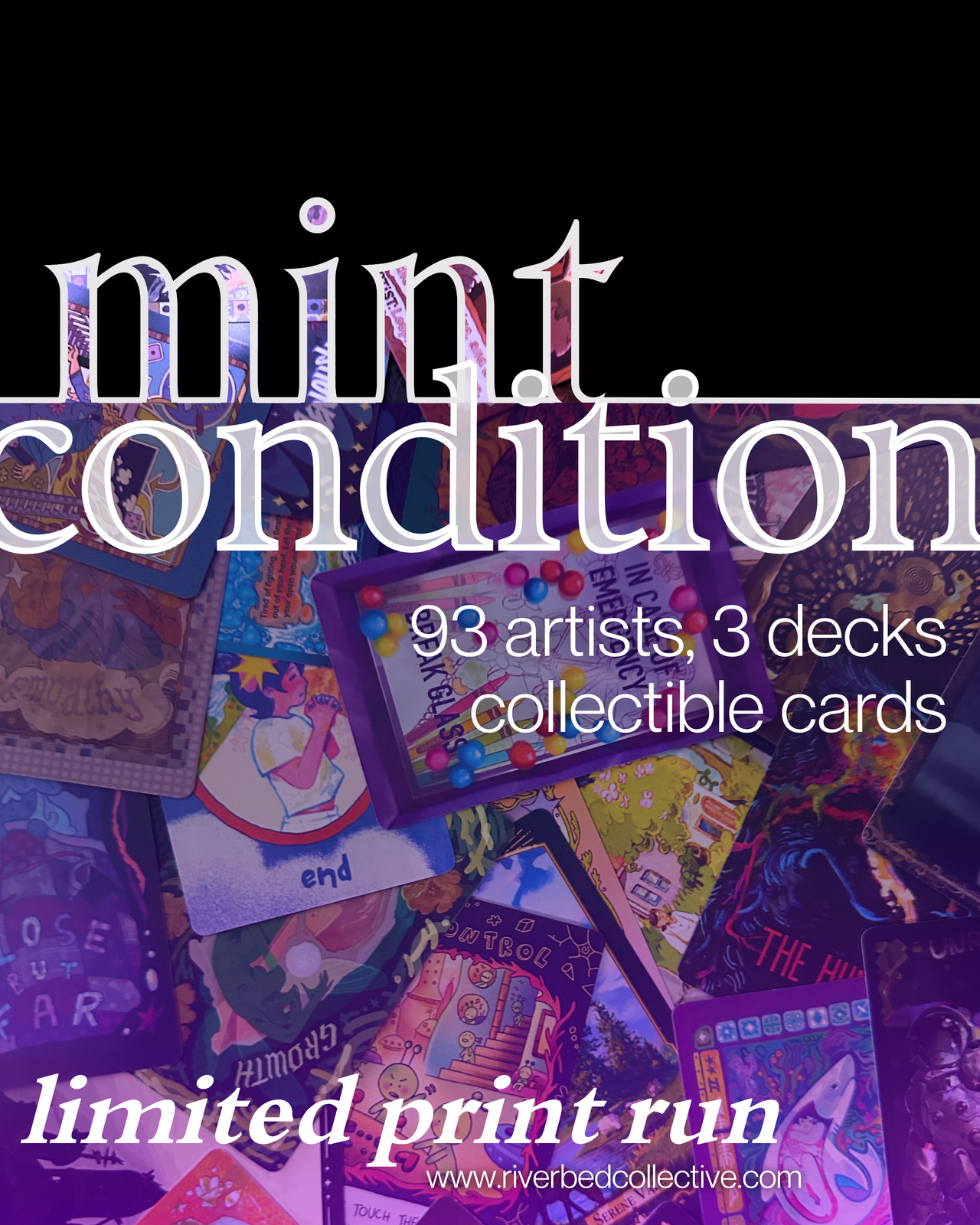
For those who are unfamiliar, Mint Condition is a collectible card project involving 90+ artists internationally. Each artist had full creative freedom to design two sides of the same card. These were sorted into three decks and physically printed. The digital copy is available here.
So, what happened?
(I’m based in Hong Kong and am located pretty close to Chinese manufacturers, so I’m currently the only one on Team Riverbed handling print production. I’m writing in the first person because I’m taking full ownership of this mistake.)
Short version of the story: I tested a print manufacturer, didn’t catch onto the red flags, and had to switch manufacturers way too late in the process.
Okay, here’s the long version.
I began researching manufacturers in June 2024, but had nothing that could be test printed, so I waited until enough cards were done.
In August 2024, I tested a manufacturer from the Chinese platform Taobao. I found the printing decent, except for one error. I tried to fix this with the manufacturer, but the calibre of their work deteriorated with each sample I made, and my quality control concerns were dismissed multiple times. Product traceability and labour practices were opaque as well. I didn’t feel good about it, but, by the time I realised I couldn’t trust this company, it was pretty late.
Preorders had already opened. Designs were already finalised. I didn’t want to make everyone alter their work.
I went to Alibaba, spoke to eight companies, found a new manufacturer, and decided to go visit their factory. They welcomed me and brought me on a tour of the entire facility. The CEO didn’t dodge my (incredibly direct) questions about living wages. I genuinely felt comforted looking at their production quality, certifications, and the heartfelt way they treated their staff.
Making the switch was a tough decision. It would require every single contributor to resize and reupload their cards. This was easy for some, but others’ designs were extremely difficult to modify. I didn’t want to waste even more time than I already had.
So, I sought help from a friend and mentor. Then, Izzy, Akko, and I discussed different options. Could we order a new, customised knife to fit the dimensions of the old manufacturer? Could we resize the cards ourselves? Neither option would give us a satisfactory result, and I didn’t want to do this behind our artists’ backs. I swallowed my pride, apologised, and explained why we were switching manufacturers.
(The artists of Mint Condition were very kind to me, thank goodness.)
As of this writing, it’s currently the Lunar New Year holiday, so the workers are home for the holidays. The cards should be ready to go into production once they’re back.
Key takeaways
- Trust your gut.
- If a business partner’s practices and attitudes make you uneasy, RUN. According to my mentor, feeling comfortable should be a prerequisite for any business partnership.
- It takes time to save time.
- This means researching companies in detail before you work with them, and perhaps visiting the facilities if possible. Be proactive; I was the one who suggested I should visit. I can write something about this if you’d like.
- Spot the red flags. Team Riverbed will likely do a resource on this soon, compiling opinions from other artists who’ve also worked with printers.
- Contracts. Please.
- Everything (delivery times, costs, file specifications, everything) should be on the contract. This protects both you and your manufacturer.
- If it’s too good to be true, it probably is.
- Be extremely wary if you suspect corners are being cut. The main example here is: our original manufacturer uses 2mm print bleed. 3mm is the industry standard, and our current manufacturer refuses to do anything below that.
- Other companies I spoke to said that they could accommodate the 2mm print bleed, but I grew suspicious, because everything seemed too good to be true; low costs, fast delivery, and could use my original file sizes? Corners were definitely being cut somewhere.
- I also feared that the corners being cut were in terms of human rights, i.e. lower production costs because worker wellbeing isn’t a priority. It might be cheaper, but it’s likely that someone else (or the environment) is paying the price.
- Swallow your pride and seek help.
- Please, don’t hide your mistakes.
- Generally, I’ve found that people are pretty forgiving when I’ve made it clear that I’ve made an effort, that my decisions are well thought-out, and that I’m making choices for the sake of quality.
Final thoughts
I’m glad we avoided disaster. I’m also glad that this mistake wasn’t financially costly; costs were incurred in the forms of time wasted and extra labour.
And, of course, I feel lucky to have the support of such a warm community. Thank you for letting me learn.
About Erin: Having co-founded Riverbed Collective, an international artist-led social enterprise, Erin thinks of herself as Doctor Frankenstein. She has a vision, then brings it to life—just without the blood and gore. Her operational and creative experience spans multiple fields, including educational theatre and cosmetic chemistry. She was born in Hong Kong, currently spends her time sketching on Naarm’s (Melbourne’s) trams, and is always searching for ways to do better. Contact her via erin@riverbed.world or linkedin.com/in/erin-ai-hei.